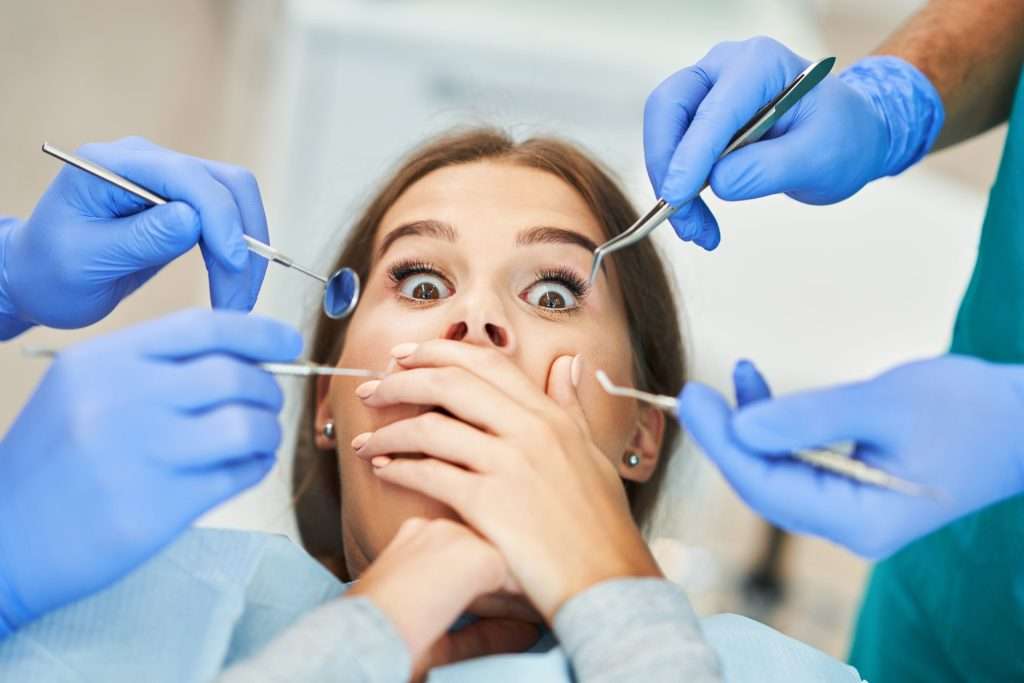
Dental anxiety – much more common than you think
If the mere thought of a visit to the dentist makes you feel queasy, you are not alone.
Approximately 40 to 50 % of all adults in Switzerland, in some form Dental anxiety.
And that's perfectly normal.
Many people have had unpleasant experiences in their childhood or adolescence – perhaps a treatment was painful, perhaps the dentist simply wasn't very empathetic back then.
I remember one patient well, let's call her Mrs. S., early 30s. She first came to me after she had not seen a dentist for over eight years. During the first conversation, she said in a trembling voice:
„"I know it's terrible, but I just couldn't do it. The mere thought of the drilling noise makes me freeze."“
It is precisely these kinds of situations that are the reason why I care about this topic. Dental anxiety so dear to my heart.
Because fear is nothing to be ashamed of – but it's also okay for you to feel it. do not deter you from your health.
What exactly is dental anxiety – and when does it become dental phobia?
Dental anxiety can manifest in very different ways.
Some people simply feel uncomfortable, others avoid the dentist for years.
There are two forms:
- Dental anxiety (dentophobia): An unpleasant but controllable feeling that is associated with stress, tension, or nervousness.
- Dental phobia: A severe anxiety disorder in which those affected actively avoid visiting the dentist – often for many years.
Typical symptoms include:
- Heart palpitations, sweating
- Sleep disturbances before the appointment
- Trembling or crying in the treatment chair
- Feelings of faintness or shortness of breath
But: Dental anxiety is treatable.
And it often disappears as soon as you feel that you heard, understood and carefully accompanied become.
How does dental anxiety develop?
Dental anxiety has many faces – and almost always a story behind it.
Here are some of the most common causes I encounter in my practice:
1. Bad experiences in the past
This is a classic case. A painful treatment as a child, an insensitive doctor, a feeling of helplessness. Such memories remain deeply stored in the subconscious.
„"I screamed as a child, and the dentist just carried on."“
– Unfortunately, I still hear this statement all the time.
2. Fear of pain
Even with modern anesthesia, many people fear that the injection or drilling might hurt. However, today's methods... almost completely pain-free – many people simply don't know that.
3. Shame about the condition of one's teeth
After years without control, many are ashamed of "how bad it looks".
I can assure you: We dentists condemn no one. We are delighted if you find the courage to come – no matter how long you have waited.
4. Loss of control
You feel vulnerable in the dentist's chair. You can't see what's happening, you hear unpleasant noises – this creates stress.
5. Fear of needles, noises, or smells
The smell of disinfectants or the hum of a drill can evoke memories.
Some people are sensitive to precisely these stimuli – even when objectively nothing threatening is happening.
Why dental anxiety must be taken seriously
Dental anxiety often leads to Avoidance behavior – and that has consequences.
Those who avoid the dentist for years risk:
- Tooth decay and gum inflammation that worsen
- Tooth loss
- Pain, inflammation, or abscesses
- Shame and social insecurity (e.g., when smiling or speaking)
Many patients tell me after their first successful treatment:
„"If I had known it could be so pleasant, I would have come much earlier."“
Therefore, my motto is: Understand dental anxiety, don't fight it.
Only if we take the fear seriously can we find ways together to reduce it step by step.
How modern dentists deal with dental anxiety
Empathetic conversations and transparency
Every treatment with us begins with a detailed consultation – without instruments, without pressure.
You tell me what worries you, and I explain in detail, what, why and how something happens.
This transparency This is crucial: If you understand what is coming, the situation loses its terror.
Slowly approaching
We do everything at your pace.
Sometimes we start with just an examination, without any treatment. At the next appointment, a minor cleaning is done, and only then do we proceed with something more extensive.
Every step you take, strengthens your trust – and that's the key.
Modern, pain-free treatment methods
No one has to endure pain anymore these days.
There are:
- Ultrasound devices instead of lots of drills,
- highly effective, gentle anesthetics,
- Vibration-free treatment systems,
- and even Treatments under twilight sedation or nitrous oxide.
Many of my anxiety patients initially opt for sedation – and are surprised how pleasant and relaxed that experience can be.
Calming environment
In modern practices, we pay attention to Light, sound and atmosphere.
Soft music, friendly colors, a pleasant scent – it sounds banal, but it makes a huge difference.
Patients often say the following when they come in:
„"This is nothing like going to the dentist – you feel comfortable here."“
That's exactly what it should be: a place where you can relax and unwind to feel safe.
Helpful strategies against dental anxiety
1. Talk openly about your fear
This is the most important step.
Tell your dentist right at the beginning that you are afraid. An experienced dentist will respond with understanding – not pressure.
2. Schedule a consultation appointment without treatment.
An initial meeting without anything being "done" helps many people to build trust.
This way you can experience the atmosphere, ask questions and notice: Here I can be myself.
3. Use relaxation techniques
Breathing exercises, meditation or progressive muscle relaxation can help to release inner tension.
Some patients bring headphones and listen to their favorite music – that's absolutely allowed!
4. Step-by-step approach
Nobody needs to undergo extensive treatment right away.
We often start with small, pleasant experiences – and every positive experience reduces anxiety for next time.
5. Bring a companion
If it helps, bring a trusted person with you.
A calming conversation before and after treatment can make a big difference.
6. Overcoming anxiety through hypnosis or sedation
Many dental practices offer treatment for patients with severe dental anxiety. dental hypnosis, Nitrous oxide sedation or Treatments under twilight sedation to.
These methods are safe, gentle, and help to make the treatment almost unnoticeable.
A personal example from my practice
One case that I particularly remember was Mr. L., a quiet, likeable man in his late 50s.
He had No dentist for over 20 years visited.
When he finally arrived, he said:
„"I know I should have come long ago. But the fear was always stronger."“
We started very cautiously – the first appointment was just a conversation, the second included a teeth cleaning under nitrous oxide.
After the third session, he said:
„"I never thought I'd be sitting here without my heart racing."“
He comes regularly now – relaxed, smiling and fearless.
These stories are the best part of my job.
Because they show: It's never too late to overcome dental anxiety.
Dental anxiety in children
Children feel emotions very strongly – and often adopt the fears of adults.
When parents say:
„"This won't hurt at all, I promise!"“
Children immediately suspect: Ah, so that could hurt.
It is better to speak neutrally:
„"The dentist will look at your teeth and explain everything to you in detail."“
In my experience, it helps to have children to introduce people to visiting the dentist in a playful way – e.g. through short check-in appointments, small rewards and a fun atmosphere.
Children who have such positive experiences develop no fear of dentists in adulthood.
Dental anxiety in adulthood: Why it often intensifies
As people get older, their fear often increases – not because the treatment is worse, but because one believes to lose moreTeeth, control, self-esteem.
Many of my patients say:
„"I haven't gone in so long, now it's probably too late."“
But that is a misconception.
Modern dentistry can now even saving severely damaged teeth or replace them painlessly.
And every treatment begins with Understanding, not accusations.
When professional help is advisable
If the fear is so strong that you They can't even call or make an appointment., Psychological support can help.
Behavioral therapy, hypnotherapy, or relaxation techniques have proven effective in treating Dental phobia Very good results have been achieved.
Often, just a short period of support is enough to overcome the inhibition threshold.
Many practices – including those in Switzerland – now collaborate with psychologists and anxiety therapists.
What modern dentistry can do for anxious patients
Dentistry has developed rapidly in recent years – especially for anxious patients.
Here are some examples:
Nitrous oxide sedation
A gentle sedative gas that significantly reduces anxiety and gagging. You remain awake but deeply relaxed.
Twilight sleep (intravenous sedation)
A combination of sleep and relaxation – you hardly notice the treatment, waking up calm and pain-free.
Treatment under general anesthesia
For major procedures or extreme dental phobia. You are completely asleep and feel nothing.
hypnosis
Gentle trance techniques help to release fears and shift the focus away from the event.
Digital technologies
3D scanners, lasers, impression-free procedures – many things that used to be unpleasant are now fear-free and contactless possible.
Conclusion: Dental anxiety is not a weakness – it is a signal
If you are afraid, it means your body is protecting you.
But sometimes you can show your body that This protection is no longer necessary..
Modern dentistry offers countless ways to overcome fear – with empathy, modern technology and patience.
I always tell my patients:
„"You don't have to be afraid anymore today – that's my job."“
Because trust is the best numbing agent.
So: Go for it.
An initial conversation, an open ear, an understanding team – that is often the beginning of a completely new dental experience.
And who knows – maybe you too will soon be among those who say after the treatment:
„"It wasn't that bad at all – actually, it was quite pleasant."“
Are you also afraid of the dentist? Make an appointment today. consultation and take the first step! 😊